
How to Have Faith in God That Grows and Produces Results Mark 11:22-24
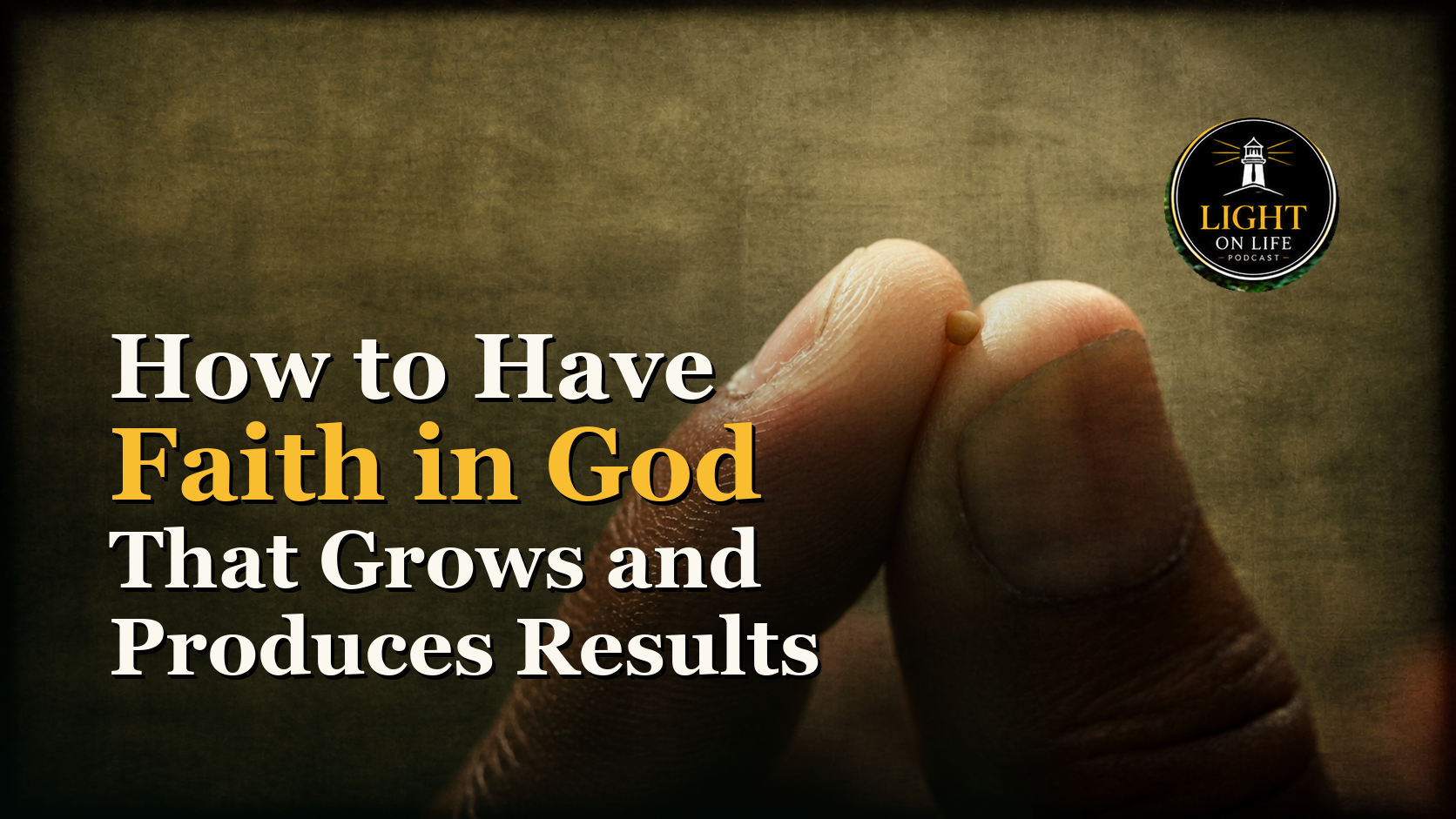
Mustard seed held between two fingers illustrating growing faith in God.
What does it really mean to have faith in God and believe that you receive when you pray? Jesus didn’t leave us guessing. In Mark 11:22–24, He tells us to have faith in God, speak believing words, and believe that we receive the things we ask for in prayer. But there’s something we need to settle before we ever get to the mechanics of faith: Can you trust the Man who said these words? Jesus’ character backs every promise He made. He lived by every Word of God, put the Father’s will ahead of His own needs, and showed us the kind of faith that makes the impossible possible. Hear Jesus. Believe Jesus. Heed Jesus. So, grab your Bible and let’s take a look at How to Have Faith in God That Grows and Produces Results. That’s our focus on this week’s Light on Life.
Listen to the Audio
This Week: Take one thing you’re believing God for, find the Scripture that covers it, believe the report, heed the instruction, and refuse to leave your faith where it is.
#S13-037
Never Miss an Episode
Join believers who are growing in God’s Word every week. Subscribe to the Light on Life Podcast on your favorite platform:
Use this if your podcast app supports adding shows by RSS feed.
Accept the Challenge
Hear It. Believe It. Heed It.
This week, take one thing you’re believing God for and go back to the Word. Find the Scripture that covers it. Don’t just read it—settle it. Ask yourself, “Do I believe this report?” Then heed what God tells you to do.
Don’t leave your faith where it is. Feed it with the Word. Keep it current. Refuse to lean away from what God said because of what you see, feel, or hear. A faith that grows is a faith that keeps hearing, keeps believing, and keeps heeding.
Remember: Don’t settle for meager faith. Hear Jesus. Believe Jesus. Heed Jesus.
Scripture:
Mark 11:22–24 (KJV) —
22 And Jesus answering saith unto them, Have faith in God.
23 For verily I say unto you, That whosoever shall say unto this mountain, Be thou removed, and be thou cast into the sea; and shall not doubt in his heart, but shall believe that those things which he saith shall come to pass; he shall have whatsoever he saith.
24 Therefore I say unto you, What things soever ye desire, when ye pray, believe that ye receive them, and ye shall have them.
Join the Conversation
Each week's podcast also contains a question designed to encourage testimony. Testimony is vital to a believers life. We overcome by it (Rev. 12:11).
This week's question:
Join This Conversation
Question:
Where are you on God’s scale of faith right now—have you been settling for meager faith, or are you actively feeding your faith and allowing it to grow?
Share:
What Scripture are you believing God for right now, and what are you doing differently because you believe that report?
Remember:
Faith does not stop with hearing. Believe what God said and heed His instruction. Hear Jesus. Believe Jesus. Heed Jesus.

About Emery and Sharon
For nearly five decades, Emery has devoted his life to helping people grow in Christ through the power of the Word and the leading of the Holy Spirit.
Together with his wife, Sharon — his partner in life and ministry for 44 years — he equipped believers to live Spirit-filled, practical lives of faith.
At the heart of the mission is this: helping believers apply God's words so faith becomes active and unstoppable.
If this episode helped you, would you share it with a friend and leave a quick review?
Podcast Notes:
Well again, welcome.
Let’s pray.
Father God, thank you for Jesus. As we approach your Word today, help us to do so with reverence and respect. Help us to hear the Word and to be doers of it. Grant unto us a spirit of wisdom and revelation in the knowledge of you. We give you all the praise, glory, and honor for these things in Jesus’ Name, Amen.
Mark 11:22–24 (KJV) — 22 And Jesus answering saith unto them, Have faith in God. 23 For verily I say unto you, That whosoever shall say unto this mountain, Be thou removed, and be thou cast into the sea; and shall not doubt in his heart, but shall believe that those things which he saith shall come to pass; he shall have whatsoever he saith. 24 Therefore I say unto you, What things soever ye desire, when ye pray, believe that ye receive them, and ye shall have them.
So, let’s recap some of our previous podcasts.
In Season 13 episode 34, we defined the nine kinds of prayer, one of which is the Prayer of Believing that You Receive.
The next podcast, episode 35, we looked at the word ’ask’—whatever things you ask when you pray.
It’s vital that you ask.
You ask even though the Lord knows what you have need of.
And with that thought, here’s the Illustration of the Day.
So Sharon and I were reading the ‘sleep Scriptures’ we found in God’s Word and thanking the Lord for them.
We did this for a couple of months and noticed little to no difference in the quality of our sleep.
After a couple of months, I inquired of the Lord as to why we weren’t getting the results that we expected.
Get this now—this is what He said.
“It doesn’t work by reading—it works by believing that you receive.”
Ah, we understood.
So, from that night forward after we read the Word, we would pray to the Lord reading to Him the very scriptures we had used from the beginning.
You know the same Scriptures that we weren’t getting any results with.
But, now we added these words: “Lord, we believe that we receive a good night’s sleep.”
“We believe that we receive sweet sleep.”
“We believe that we receive the fact that you give your beloved sleep.”
“We believe that when we lie down we will do so in peace and safety.”
There was an immediate difference the first night.
It even got better on the next few nights.
After awhile, we added to that prayer these words, “Father God, we also asked that we would fall asleep quickly, and that we would have no long periods of time where we were up tossing and turning.
That addition produced as well.
The point that the Lord made to us is that you have to ask, not just read the Word.
That’s what the Word of God says—He was very precise about the directions.
If He is precise about the directions, you need to be precise about it also.
God does not waste words.
Then in the last podcast episode 36, we spent the entire podcast, establishing the importance of not leaning to your own understanding.
That is, when we’re trying to select a Scripture, ask for the Holy Spirit’s help.”
So again—the first thing we need to do is find scriptures that cover the thing that we’re asking for.
Now that we have that scripture from the Helper, the Holy Spirit of God, let’s go to the next area.
The Fig Tree and the Character of Jesus
Jesus is getting ready to give us life-altering prayer truths.
Mark 11:23–24 (KJV) — 23 For verily I say unto you, That whosoever shall say unto this mountain, Be thou removed, and be thou cast into the sea; and shall not doubt in his heart, but shall believe that those things which he saith shall come to pass; he shall have whatsoever he saith. 24 Therefore I say unto you, What things soever ye desire, when ye pray, believe that ye receive them, and ye shall have them.
Notice the phrase ‘verily I say unto you’ in verse twenty-three and ‘Therefore I say unto you’ in verse twenty-four.
So, Jesus autographed these verses for us with these two statements.
Why did He do it?
Why didn’t Jesus give us the instruction without the words ‘I say unto you?’
I say unto you could be translated into modern-speak, ‘this is me—Jesus—that’s talking.’
The character behind the man talking establishes the talk of a man.
People don’t buy into what you say, they buy into who you are.
What kind of man is this who was saying, ‘Verily, I say unto you?’
Let’s start there.
And with that thought, here is the Definition of the Day.
Don’t treat the word ‘verily’ [amen] lightly.
We think it’s a word that takes up space because it’s a word we don’t use.
We use other words like truly or truthfully.
The word ’verily’, transliterated ‘amen’, is a strong and solemn declaration used only by Jesus.[1. William Arndt et al., A Greek-English Lexicon of the New Testament and Other Early Christian Literature (Chicago: University of Chicago Press, 2000), 53.]
You never heard Paul or any of the New Testament writers say, “Truly, I say unto you.”
So, what Jesus shares in Mark 11:23 and 24 is His Amen, His strong and solemn declaration.
Jesus’ Amen is backed by His character.
And Mark gives us a glimpse of that character before Jesus ever says, “Have faith in God.”
The glimpse comes through a very ordinary scene—Jesus was hungry.
Jesus Lived by Every Word of God
Look at Mark 11:12.
Mark 11:12–14 (KJV) — 12 And on the morrow, when they were come from Bethany, he was hungry: 13 And seeing a fig tree afar off having leaves, he came, if haply he might find any thing thereon: and when he came to it, he found nothing but leaves; for the time of figs was not yet. 14 And Jesus answered and said unto it, No man eat fruit of thee hereafter for ever. And his disciples heard it.
The Scripture says ‘Jesus was hungry.’
Hunger goes to character.
You will see why in a moment.
The Greek word translated ‘became hungry’ [peinaō] means to feel the sharp pain of hunger.
We modern—ites use the term pangs of hunger.
Jesus’ gnawing experience was a drawn-out affair—a deprivation that didn’t come by missing breakfast.
This was not the first time Jesus felt sustained hunger.
Matthew 4:2 (NASB 2020) — 2 And after He had fasted for forty days and forty nights, He then became hungry.
Here’s the character piece—watch the reaction.
Matthew 4:3–4 (NASB 2020) — 3 And the tempter came and said to Him, “If You are the Son of God, command that these stones become bread.” 4 But He answered and said, “It is written: ‘MAN SHALL NOT LIVE ON BREAD ALONE, BUT ON EVERY WORD THAT COMES OUT OF THE MOUTH OF GOD.’ ”
The word ’every’ [panti] means totality without exception.
Totality means every word.
Each and every word.
Any and every word—comes before eating.
Do you feel that way about God’s Word?
Jesus didn’t become ‘hangry’—the new modern word for hungry and angry.
His priorities were on display: God’s food, the Word of God, above man’s food.
What Jesus Put Ahead of Eating
Now, flip over to Matthew 6:25–26.
Matthew 6:25–26 (NASB 2020) — 25 “For this reason I say to you, do not be worried about your life, as to what you will eat or what you will drink; nor for your body, as to what you will put on. Is life not more than food, and the body more than clothing? 26 Look at the birds of the sky, that they do not sow, nor reap, nor gather crops into barns, and yet your heavenly Father feeds them. Are you not much more important than they?
When you read this, you must ask the question: How come God the Father didn’t feed Jesus?
Jesus was hungry—the same Jesus that by the power of the Heavenly Father, blessed and broke bread and fed 5000 men on one occasion and 4000 on the next.
Why didn’t He multiply His own food?
Remember what we’re looking at—the character of the Man who is about to tell us, “Believe that you receive.”
What did Jesus do when His own physical needs collided with the work His Father gave Him to do?
Mark 3:20 (NASB 2020) — 20 And He came home, and the crowd gathered again, to such an extent that they could not even eat a meal.
A few chapters later, the same thing.
Mark 6:31 (NASB 2020) — 31 And He said to them, “Come away by yourselves to a secluded place and rest a little while.” (For there were many people coming and going, and they did not even have time to eat.)
These are little pixels that begin to form a picture.
John 4:31 (NASB 2020) — 31 Meanwhile the disciples were urging Him, saying, “Rabbi, eat something.”
The word urging means to beg.
The disciples were begging Jesus to eat.
The character of the man?—Here it is.
John 4:32–34 (NASB 2020) — But He said to them, “I have food to eat that you do not know about.” 33 So the disciples were saying to one another, “No one brought Him anything to eat, did he?” 34 Jesus said to them, “My food is to do the will of Him who sent Me, and to accomplish His work.”
The Greek word ’accomplish’ [teleioō] means to complete and bring an activity to a successful finish.[2. Johannes P. Louw and Eugene Albert Nida, Greek-English Lexicon of the New Testament: Based on Semantic Domains (New York: United Bible Societies, 1996), 657.]
My Jesus—your Jesus was so focused on accomplishing—finishing—all of the works that His Father gave Him to do that He put that above eating.
What were those works?—in a word? Helping other people.
God the Father wants to help people.
He wants to save people, deliver people, and heal people.
When Jesus chose to minister to the crowds of sick people rather than eating, do you see the insides of the man?
Jesus was willing to stay hungry by choice.
Behold the Man.
He didn’t selfishly turn stones into bread.
He allowed crowds to interrupt His meals.
He went without food because people needed ministry.
He told His disciples that doing His Father’s will was food to Him.
That is the Jesus who turns to you and says, “Amen—I say unto you…”
Therefore, when He tells you, when you pray, believe you receive it and you will have it—you better know that it’s so.
A man of this character doesn’t make empty promises.
Have you bought into this man, Christ Jesus?
Hear Jesus. Believe Jesus. Heed Jesus.
Do You Feel the Way Jesus Did About God’s Will?
Jesus put serving others, and finishing the Father’s work before His physical need to eat.
Do you feel this way about God’s Word?
Do you feel it’s vital to accomplish the work God gave you to do?
Is your mindset that you need the total Word of God—every Word from Heaven—more than you need necessary food?
Now don’t lose why we’ve looked at all of this.
We’re examining the character of the Man who said, “Verily I say unto you.”
He put the Word ahead of bread.
He put the Father’s will ahead of His own hunger.
He put helping people ahead of His own convenience.
That’s the Man speaking in Mark eleven.
So now, watch this same hungry Jesus walk up to a fig tree.
What Faith Makes Possible?
Jesus declares to us that when we pray, believe that we receive.
Maybe you think that your situation is much too big to even pray about.
Or maybe you’re so used to handling things by yourself that it never occurs to you to pray.
Our problems seem to us a maze of complications that we try to unwind because that’s how we’ve always functioned.
Watch Jesus walk up to a fig tree and curse it.
Mark 11:14 (KJV) — 14 And Jesus answered and said unto it, No man eat fruit of thee hereafter for ever. And his disciples heard it.
In that moment, these words didn’t solve Jesus’ hunger problem but what He demonstrated can solve yours today.
Jesus wasn’t merely wishing something would happen. He spoke the will of God concerning that tree: “May no one ever eat fruit from you again.”
Mark 11:20–21 (KJV) — 20 And in the morning, as they passed by, they saw the fig tree dried up from the roots.
Oh, we need to discuss ‘dried up from the roots.’
There’s great encouragement here for the Jesus follower.
The Greek word ’dried up’ [xērainō]—to stop a flow (such as sap or other liquid) in something and so that it dries-up.
Think about it—spoken words that stop a flow.
I hear a noisy crowd.
I hear the faint patter of steps.
I hear the words ‘If I can just touch His clothes, I shall be whole.’
Hear the words—know the result.
Mark 5:29 (NASB 2020) — 29 And immediately the flow of her blood was dried up; and she felt in her body that she was healed of her disease.
Spoken words dried up the flow—except it wasn’t Jesus’ words.
It was her words.
Your words—words that you believe in your heart—words that come from having heard about Jesus—words that come from having read about Jesus right here in your Bible.
You read them—you acted on them— and those words did their duty and dried up the flow.
Hear Jesus. Believe Jesus. Heed Jesus.
The Faith You Must Have
Mark 11:22 (NASB 2020) — 22 And Jesus answered and said to them, “Have faith in God.”
The casual reader locks in on the word faith here.
But I already know that you are not the sloppy Bible reader.
As a serious student of Scripture, you’ve looked deeply at the word ’have’ [echo] and you understand that this word Jesus used is not a suggestion.
It’s a commandment.
Jesus is not saying that you should have faith—He is saying you MUST have faith.
This is not negotiable.
There’s no other way to receive than to believe that you do.
As a child of God, Jesus commands you to “keep” or “retain” faith under all circumstances.[3. G. F. Maclear, The Gospel According to St Mark, Cambridge Greek Testament for Schools and Colleges (Cambridge: Cambridge University Press, 1892), 222.]
This must-have-faith must be current-faith.
Faith in the now.
I know you’re sharp because you observed that the word ’have’ [echo] is a present tense active verb.
Present faith is not past tense faith—it’s active right now faith.
It’s not faith you’re trying to acquire: “If I could just have enough faith, maybe I can believe I receive.”
This faith is maintained—sustained faith.
You know your driver’s license must be current, so does your faith.
So possible faith is right now faith.
How Faith Comes
Once more, Jesus said, “Have faith in God.”
The next question begs to be asked: How does faith come?
We’re supposed to have it—that’s great to know, but isn’t it better to know how to acquire it in the first place?
Romans 10:14–17 (NASB 2020) — 14 How then are they to call on Him in whom they have not believed? How are they to believe in Him whom they have not heard? And how are they to hear without a preacher? 15 But how are they to preach unless they are sent? Just as it is written: “HOW BEAUTIFUL ARE THE FEET OF THOSE WHO BRING GOOD NEWS OF GOOD THINGS!” 16 However, they did not all heed the good news; for Isaiah says, “LORD, WHO HAS BELIEVED OUR REPORT?” 17 So faith comes from hearing, and hearing by the word of Christ.
Look at the word ’hearing’ [akoē] in verse seventeen.
Hearing means that which is heard.
It’s the same word as ’report’ in verse sixteen: who has believed our report.
Once again hearing and report are the same word.
What report is that we are to hear?—well, it’s the Word of Christ.
Faith comes by hearing that Word of Christ.
So what produces faith is not the simple mechanics of hearing.
Who has believed the report—who has believed what they heard?
You can hear the weather report and not believe it.
It happens all the time.
The weatherman says a storm is coming and you cast a disbelieving eye.
The actions prove your lack of faith in the weatherman: no raincoat, no umbrella, not even a hat just in case.
But if you believe the report, you act differently.
Out comes the rain jacket.
You make sure there’s an umbrella in the car.
You calculate the steps to the front door of your work: ‘How fast can I make it to the front door without getting drenched?’
You prepare.
Why?—you believed what you heard.
Now is Jesus a more reliable witness than the weatherman?
The word that you hear, you must reach out and believe.
Hear Jesus. Believe Jesus. Heed Jesus.
Do you understand why we have said, “Find Scripture that promises you the thing you are asking?”
Faith doesn’t just come by hearing—it comes by heeding.
Romans 10:16 (NASB 2020) — 16 However, they did not all heed the good news; for Isaiah says, “LORD, WHO HAS BELIEVED OUR REPORT?”
The word ’heeding’ means to follow instructions, obey, be subject to.
That enlarges our definition: Faith comes by believing the report—the Word of Christ—and by obeying and subjecting yourself to the instructions you heard.
If you don’t submit, you don’t believe.
It’s amazing how imprecise we are about what it means to believe.
Where Is Your Faith on God’s Scale?
Matthew 17:19–20 (NASB 2020) — 19 Then the disciples came to Jesus privately and said, “Why could we not cast it out?” 20 And He said to them, “Because of your meager faith; for truly I say to you, if you have faith the size of a mustard seed, you will say to this mountain, ‘Move from here to there,’ and it will move; and nothing will be impossible for you.”
Meager faith is not the faith Jesus told us to have.
There is nothing meager about ‘whosoever shall say unto this mountain, be removed and cast into the sea.’
You need more than meager faith to get that result.
Can you see that you cannot afford to leave your faith where it is?
You must actively engage the Word of God and the faith that comes by it.
Now we’re getting to what will add value to your life.
Faith is measurable.
I used to say that, “Even if you have little faith, it will produce.”
Some cases yes—some cases no.
I held to that thought until I understood the difference between meager faith and mustard seed faith.
Meager faith is not even mustard seed caliber faith.
Mustard seed was the smallest seed an agricultural farmer of the first century would sow.
But there are smaller seeds.
The orchid seed is 15 to 30 times smaller than mustard seed.
All seed is not the same size.
All faith isn’t either.
According to the New Testament, faith can be zero in size.
The New Testament has a word for that—it’s called unbelief.
Unbelief is not little faith—it’s atheist territory.
The word for faith is pistis—the word for unbelief is apistia.
That little ‘a’ in front of pistis flips faith on its head.
Faith is measurable on a scale.
On one end—unbelief.
Move up the scale—meager faith.
Keep moving—mustard seed faith.
But don’t stop there.
Because the New Testament shows us faith that keeps growing.
Exceedingly growing faith.
2 Thessalonians 1:3 (NASB 2020) — 3 We ought always to give thanks to God for you, brothers and sisters, as is only fitting, because your faith is increasing abundantly, and the love of each and every one of you toward one another grows ever greater.
This is the faith Jesus wants you to have, the increasing abundant kind.
Increasing abundantly means growing beyond normal expectations.
That’s the kind of faith Jesus wants you to have.
A faith that doesn’t settle.
A faith that is active and ready to fight.
A faith that refuses to deviate but heeds God’s instruction.
Hear Jesus. Believe Jesus. Heed Jesus.
Now we’re talking production.
Where are you on God’s scale?
Putting the Word of God Into Action
So, where are you on God’s scale of faith?
Don’t answer that question based on how you feel.
Don’t answer it based on your last faith success or failure.
Go back to the Word of God.
Jesus said, “Have faith in God.”
That means you can.
Find the Word from God that covers what you’re asking for.
Then make your decision.
“I believe God.”
Once you make that decision, heed what He told you to do.
Don’t lean away from the Word because the circumstances haven’t changed yet.
Don’t back away because somebody tells you why it can’t happen.
Keep the faith you have now.
Feed it.
Believe the report.
Heed the instruction.
That’s how faith grows.
Hear Jesus. Believe Jesus. Heed Jesus.
Accept the Challenge
Here’s your challenge this week.
Take one thing you’re believing God for and put it through what we learned today.
Find the Scripture that covers it.
Read it until you know exactly what the Lord is saying to you.
Ask yourself, “Do I believe this report?”
If the answer is yes, then act like you believe it.
Heed the instruction.
Refuse to deviate from what God said because of what you see, feel, or hear.
Don’t settle for meager faith.
Let your faith increase abundantly.
Hear Jesus. Believe Jesus. Heed Jesus.
If this podcast helped you, consider sharing it with others.
This and other podcasts are available for you.
You’ll find the Companion Study Guide and Teacher’s Guide for this episode on the Episode Resources page at emeryhorvath.com, as well.
Use those resources to go back through the Scriptures we covered today and get these truths down in your heart.
And join me next week as we continue looking at the Prayer of Believing that You Receive.
How to Have Faith in God That Grows and Produces Results.
You guys have a great God week and we will see you next time for another edition of Light on Life.
📚 Study Resources
Go deeper personally or lead this lesson with a group.
🎧 Never Miss an Episode
📩 Get Weekly Study Tools
Join the mailing list for new episodes, guides, and resources every Tuesday at 2:00 AM CST.
Subscribe by Email →🎧 Suggested Episode
If “How to Have Faith in God That Grows and Produces Results” encouraged you, don’t miss “How God’s Revealed Word Surges Remarkable Life in Him”—discover how God’s revealed Word produces life in you and why feeding on what God has said is essential to a faith that continues to grow.
Visit the Episode →References
- William Arndt et al., A Greek-English Lexicon of the New Testament and Other Early Christian Literature (Chicago: University of Chicago Press, 2000), 53. ↩︎
- Johannes P. Louw and Eugene Albert Nida, Greek-English Lexicon of the New Testament: Based on Semantic Domains (New York: United Bible Societies, 1996), 657. ↩︎
- G. F. Maclear, The Gospel According to St Mark, Cambridge Greek Testament for Schools and Colleges (Cambridge: Cambridge University Press, 1892), 222. ↩︎