
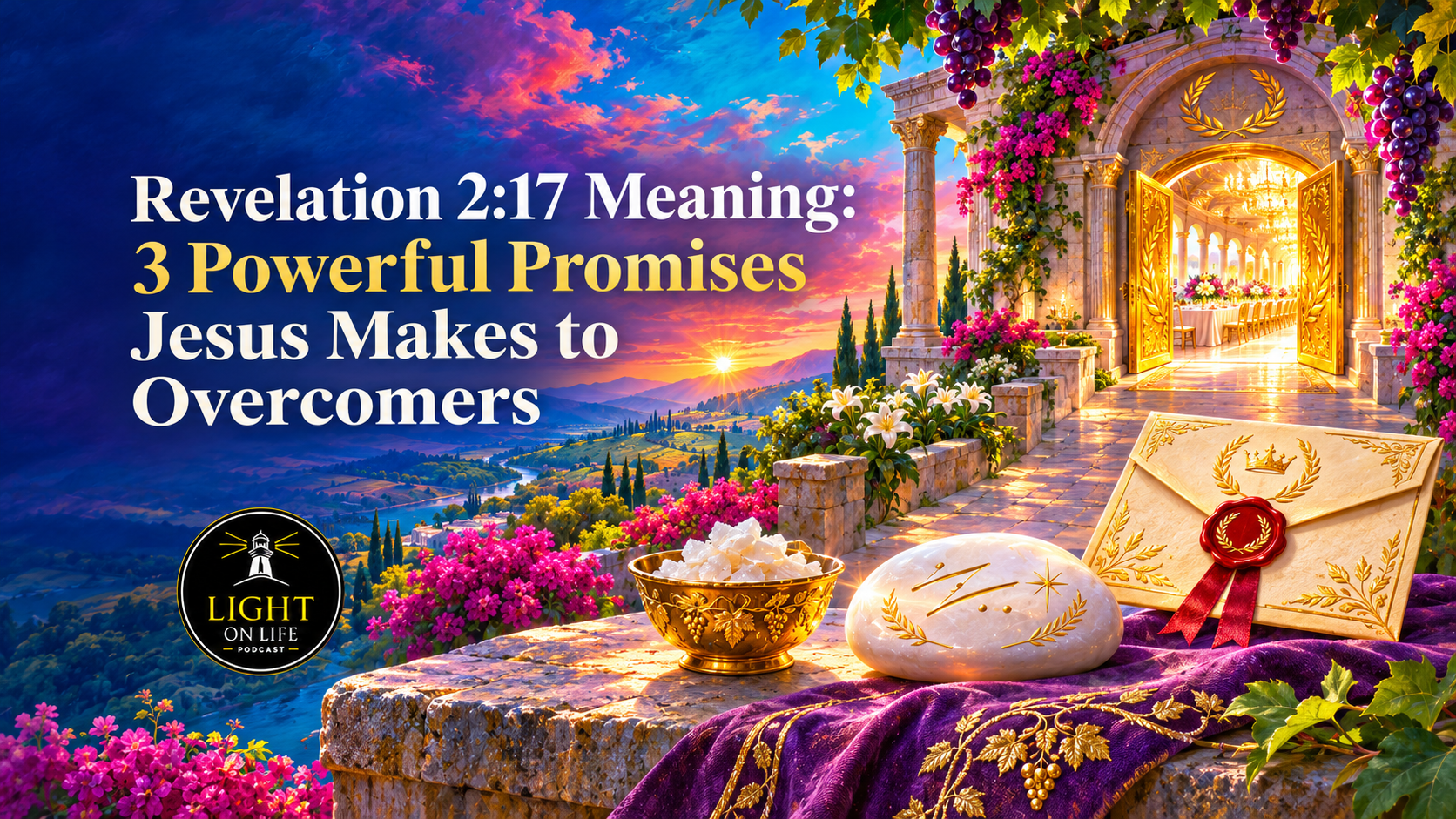
Light on Life podcast artwork for Revelation 2:17, featuring three promises to overcomers: a golden bowl filled with white manna, a white stone engraved with a new name, and a sealed golden invitation. An open doorway glows with heavenly light amid colorful flowers, vineyards, and a vibrant sunset.
Jesus never told His followers to compromise with the world to make life easier. In fact, He called them to overcome, even in the face of tremendous opposition. Think about the believers in Pergamos. They lived in a city where idolatry, emperor worship, and immorality were woven into everyday life. Standing for Jesus in that kind of environment wasn’t easy. There was pressure to conform—to go along with the crowd—to deny what they believed. But Jesus called them to hold fast to His Name and refuse to deny their faith in Him. That’s the no-compromise life. Now, you know that the world has changed considerably since the first century, but has the pressure to compromise disappeared? No way! And the call of Jesus to overcome hasn’t changed either. In Revelation 2:17, Jesus makes three tremendous promises to the one who overcomes. He speaks of hidden manna, a white stone, and a new name that no one knows except the one who receives it. What do these three promises mean? Why would Jesus make these particular promises to believers living under such tremendous pressure? That’s what we’re looking at today, so grab your Bibles and let’s analyze Revelation 2:17: 3 Powerful Promises Jesus Makes to Overcomers all on this week’s Light on Life.
Listen to the Audio
This Week: Discover the meaning of the hidden manna, white stone, and new name in Revelation 2:17, and why Jesus promises these three extraordinary rewards to those who overcome.
#S13-047
Never Miss an Episode
Join believers who are growing in God’s Word every week. Subscribe to the Light on Life Podcast on your favorite platform:
Use this if your podcast app supports adding shows by RSS feed.
Accept the Challenge
Refuse Compromise. Overcome. Receive Your Reward!
Jesus promised hidden manna, a white stone, and a new name to those who overcome. These are tremendous rewards, far greater than anything this world can offer.
Here's your challenge this week:
Examine your life. Is there an area where you've allowed the pressure of this world to move you toward compromise? If there is, repent and make the adjustment. Hold fast to Jesus and His Word. Remember, the invitation to the Marriage Supper of the Lamb is worth far more than anything compromise can offer.
Revelation 19:9 (NASB 2020) — Then he said to me, “Write: ‘Blessed are those who are invited to the wedding feast of the Lamb.’” And he said to me, “These are the true words of God.”
Refuse Compromise—Overcome—Receive Your Reward!Join the Conversation
Each week's podcast also contains a question designed to encourage testimony. Testimony is vital to a believers life. We overcome by it (Rev. 12:11).
This week's question:
Join This Conversation
Jesus promised three remarkable rewards to those who overcome: hidden manna, a white stone, and a new name known only to the one who receives it. Which of these promises speaks most powerfully to your heart, and why?
Share: Share your thoughts in the comments. I'd love to hear what the Holy Spirit is showing you about overcoming, holding fast to Jesus, and the rewards He has prepared for His followers.

About Emery and Sharon
For nearly five decades, Emery has devoted his life to helping people grow in Christ through the power of the Word and the leading of the Holy Spirit.
Together with his wife, Sharon — his partner in life and ministry for 44 years — he equipped believers to live Spirit-filled, practical lives of faith.
At the heart of the mission is this: helping believers apply God's words so faith becomes active and unstoppable.
If this episode helped you, would you share it with a friend and leave a quick review?
Podcast Notes:
Well, again, welcome.
Let’s pray.
Father God, thank you for Jesus and thank you for the Holy Spirit who is our teacher and our guide. Help us today. Grant unto us spiritual wisdom and insight, and above all, help us be doers of the Word and not hearers only. In Jesus’ Name, Amen.
Summary — The Church at Pergamos: Hold Fast and Refuse Compromise
In our previous podcast, The Church in Pergamum: How to Hold Fast and Overcome, we saw how Jesus commended those who held fast to His Name, confronted those who compromised, and called them to repentance.
The church at Pergamos faced tremendous pressure to compromise while living in a city Jesus identified as Satan’s throne.
Surrounded by emperor worship, idolatry, and false gods, they faced constant pressure to compromise their faith.
Yet Jesus commended them for holding fast to His Name and refusing to deny Him, even when Antipas was martyred for his faithful witness.
We learned that hold fast [krateō] (krah-TEH-oh) means to cling tenaciously to something, refusing to let go even when opposition comes.
But there was a problem.
Some in the church were holding fast to the wrong things—the doctrines of Balaam and the Nicolaitans.
These teachings opened the door to idolatry, immorality, and compromise.
Jesus' answer was repentance—not merely feeling sorry, but changing your thinking and the direction of your life.
We saw that principle illustrated in the life of Chuck Colson, whose repentance led to a completely different course in life.
So here’s the question: What are you holding fast to?
Jesus and His Word, or something you’ve allowed into your life because of pressure to conform?
Hold fast. Refuse compromise. Overcome.
Now, that brings us to Revelation 2:17, where Jesus makes a tremendous promise to the one who overcomes.
What does overcoming look like, and what does Jesus promise to give those who overcome? That’s where we’re going today.
So Refuse Compromise—Overcome—Receive Your Reward!
The Location of the Seven Churches
So we are looking at the church in Pergamos today.
Pergamos is the third of seven churches that Jesus addresses in the vision given to the Apostle John while on the island of Patmos.
The seven churches are:
Ephesus — Revelation 2:1.
Smyrna — Revelation 2:8.
Pergamum — Revelation 2:12.
Thyatira — Revelation 2:18.
Sardis — Revelation 3:1.
Philadelphia — Revelation 3:7.
Laodicea — Revelation 3:14.
If you look at a map of these seven churches, you see they form a kind of circular route from first to last.
The seven churches of Revelation 2–3 were in what is now western Turkey.
Jesus addressed them in an order that followed this circular route
Jesus starts with Ephesus in Revelation 2 then addresses Smyrna, which was 40 miles north.
Then Pergamum, 65 miles further north, and then the circle swings around southeast to Thyatira 45 miles away—on to Sardis 30 miles more southeast, then continuing the circular route to Philadelphia 28 miles away and finally topping out at Laodicea 45 miles away.
These are all approximate distances.
So that was the route through the seven churches—if you went eleven more miles from Laodicea, you would be in Colossae and the church there.
The entire circular route was approximately 250 miles, and a good man could cover that distance in roughly 15 days, give or take a few.
The island of Patmos, where John abode in exile and received this revelation of Jesus, was close to Ephesus (southwest).
So if a message went out from Ephesus, it could hit the Colossians in about two weeks.
Here’s a question to ponder: why do you think the Colossians were left out of the message to the churches?
They were sitting right at the end of this circular geographical route.
General Introduction to Jesus’ Message to the Seven Churches
The structure of Jesus’ message is basically the same for all seven churches.
Let’s take the Church at Pergamos as an example.
First came the command from Jesus to write.
Revelation 2:12a (KJV) — 12 And to the angel of the church in Pergamos write…
Second, came a description that Jesus shared about Himself.
Revelation 2:12b (KJV) — 12 …These things saith he which hath the sharp sword with two edges;
Third, Jesus shared with John a personal critique of the church, some positive and some not so positive.
Revelation 2:13–15 (KJV) — 13 I know thy works, and where thou dwellest, even where Satan’s seat is: and thou holdest fast my name, and hast not denied my faith, even in those days wherein Antipas was my faithful martyr, who was slain among you, where Satan dwelleth. 14 But I have a few things against thee, because thou hast there them that hold the doctrine of Balaam, who taught Balac to cast a stumblingblock before the children of Israel, to eat things sacrificed unto idols, and to commit fornication. 15 So hast thou also them that hold the doctrine of the Nicolaitans, which thing I hate.
Fourth, there was a call to repent for every church except Smyrna and Philadelphia.
To Pergamos, Jesus said:
Revelation 2:16 (KJV) — 16 Repent; or else I will come unto thee quickly, and will fight against them with the sword of my mouth.
Fifth, Jesus gave the command to hear and obey.
Revelation 2:17a (KJV) — 17 He that hath an ear, let him hear what the Spirit saith unto the churches…
Sixth, Jesus gave promises to those who overcome.
Revelation 2:17b (KJV) — 17 …To him that overcometh will I give to eat of the hidden manna, and will give him a white stone, and in the stone a new name written, which no man knoweth saving he that receiveth it.
So you may ask yourself, “Why should this concern me? Wasn’t Jesus talking to these seven churches of the first century? I’m living 2,000 years later, in the 21st century.”
Great question.
Go back to the front part of verse 17, and you’ll see the answer.
Revelation 2:17a (KJV) — 17 He that hath an ear, let him hear what the Spirit saith unto the churches…
Did you hear it?
The word ‘churches’ is plural.
So each of the seven churches received their distinct message, but the command to hear was to ALL the churches.
You are in the church now—so the message to overcome is for you as well.
Now that you have the basic structure of these seven letters, let’s drill into what Jesus said about overcoming.
What Is an Overcomer?
To the believers in Pergamos, Jesus said:
Revelation 2:17b (KJV) — 17 …To him that overcometh…
Let’s define what an overcomer is.
And with that thought, here is the Definition of the Day.
Behind the English word overcometh stands the word [nikaō] (nee-KAH-oh), which means to win in the face of obstacles, be a victor, conquer, overcome, or prevail[1. William Arndt et al., A Greek-English Lexicon of the New Testament and Other Early Christian Literature (Chicago: University of Chicago Press, 2000), 673.].
The word can describe overcoming in a military conflict.
No one wants to be on the losing side of a war.
The word can describe athletic competitions.
No Olympic athlete wants to come in second—they all seek the gold.
The word can also describe winning in legal matters.
Who wants to lose a court case?
Now, again, overcome means to win in the face of obstacles—be victorious—or to prevail.
Yet in Revelation, the word signifies triumphing over life’s struggles, particularly opposition to your witness as a disciple of Jesus.
Now, another critical part of this word, overcome, is that the tense shows us that Jesus is talking about a continuous, ongoing victory and not a one-time event.
So the Jesus’ standard is not to win a few, or lose a few.
No, the believer is to ‘fight the good fight of faith’ and win every time.
It’s not a good fight if you lose.
So what were the believers in Pergamos supposed to overcome?
Well, we covered that in a previous podcast, “The Church in Pergamum: How to Hold Fast and Overcome.”
This church had members that subscribed to the teaching of the Nicolaitans, who taught that immorality and idolatry were okay.
These believers frequented idolatrous temples and engaged in lewdness and did that so that they would align themselves with the world basically to save their skin.
Instead of transforming the world—some believers in Pergamos conformed to it.
So when I say ‘win a few, lose a few’, I mean compromising a little here or there.
Now, what are some traits of the successful overcomer?
I say successful because some are being overcome instead of overcoming.
What Are the Traits of a Successful Overcomer?
A Jesus-style overcomer is both a hearer and a doer of God’s Word.
He that has an ear, let him hear and adjust accordingly.
An overcomer tenaciously clings to the Lordship of Jesus and refuses to compromise with false teaching or worldly ideology to save his skin.
He boldly and firmly holds to the Name of Jesus.
An overcomer remains faithful even in the face of adverse conditions all the way to the finish line.
2 Timothy 4:7 (NASB 2020) — 7 I have fought the good fight, I have finished the course, I have kept the faith;
Let me tell you, you’re kidding yourself big time if a minor hurdle keeps you from reading and studying your Bible, praying, and going to church while you are living in a country that allows religious freedom.
If you can’t overcome yourself, how will you overcome severe persecution?
An overcomer is one who is quick to repent and swift to make adjustments.
He stands as a fervent lover of Jesus, and this very passion guides his behavior.
So you see, to be a constant overcomer requires a constant mindset.
Remember: Refuse Compromise—Overcome—Receive Your Reward!
Revelation 2:17: The Promise to the Overcomer
There is always a prize associated with overcoming.
Military overcomers reap the spoils of war.
Athletes garner the gold.
Those victorious in legal matters get justice.
But what about Jesus’ followers—what do they receive?
For the believers in Pergamos, Jesus said that the fruit of overcoming is:
Hidden Manna Meaning in Revelation 2:17
Revelation 2:17b (KJV) — 17 …To him that overcometh will I give to eat of the hidden manna…
Hidden manna?
What in the world is that?
The word manna leads us back to the adventures of the children of Israel in the wilderness where God directed them to gather manna, supernatural bread from heaven, that appeared on the ground every morning.
And with that thought, here is the Question of the Day.
How much manna did God provide in one day for the children of Israel?
The answer varies depending on whether you consider the population of Israel at this time to be 2 or 3 million people.
Let’s just take up both figures.
Each person was to gather an omer, which is approximately four to five pints.
Now, pints are a measurement of volume—not weight.
But if we use water as a comparison, since we know what it weighs, look at how the numbers come out.
Multiply four to five pints by 2 million people—you have around 4,700 tons of manna per day.
On Friday, they were to gather twice that amount to get them through the Sabbath—that’s 9,400 tons of manna.
I like Rick Renner’s quote here.
He said: “Hoarding manna would have caused the Israelites to trust in their supply rather than trust in the God who supplies”.[2. Rick Renner, Sparkling Gems from the Greek, vol. 2 (Harrison House Publishers), 1344–45, Kindle edition.]
God supplied it every day—every week—every month.
If you take 3 million as the population of Israel at this time, now, you have about 7,100 tons per day and 14,200 tons of manna on Fridays.
What a staggering miracle!
I’m talking over 14,000 tons in one day!
So you can see it was no problem for Jesus to feed 5,000 men, besides women and children, by the mighty hand of God.
To the children of Israel, manna represents the faithfulness of God to His people.
To Israel, manna represents their dependence on God.
But to the Jesus’ follower, manna means even more.
It means both provision and presence.
Manna represents our redemption by God in Christ, Jesus.
John 6:32–33 (NASB 2020) — 32 Jesus then said to them, “Truly, truly, I say to you, it is not Moses who has given you the bread out of heaven, but it is My Father who gives you the true bread out of heaven. 33 For the bread of God is that which comes down out of heaven and gives life to the world.”
Now, Jesus says to you as an overcomer—“If you overcome, I will give you the hidden manna.”
Now, ask yourself, why is it hidden?
The word means just that—to be concealed.
The first thing you need to understand is that this manna is hidden FOR you.
God is still in the manna feeding business!
He gives us this day our daily bread; that’s Matthew 6:11.
But this manna also points to the Marriage Supper of the Lamb.
Wow!
It’s hidden for you.
Do you think it’s possible that we could have manna served to us at the great Marriage Supper of the Lamb?
Revelation 19:9 (NASB 2020) — 9 Then he said to me, “Write: ‘Blessed are those who are invited to the wedding feast of the Lamb.” And he said to me, “These are the true words of God.”
Now, the Marriage Supper of the Lamb is before the Millennial Reign of Jesus begins.
So I said that manna symbolizes provision and presence.
Do you think God is going to take care of you in the Millennium?
Of course, He is.
Saints of God will rule for Jesus all over the planet.
Jesus will be based in Jerusalem—you might be assigned anywhere around the globe.
But mark it down—El-Shaddai, the All Sufficient One, will provide for you hidden manna, right where you are.
Now, here’s the lesson for the believers of Pergamos.
Manna from God is better than manna from idols.
Pergamum believers were being pressured to participate in meals associated with idolatry.
Jesus’ promise to this church is an offer of God’s superior food to faithful believers instead of things sacrificed to idols.[3. Alexander E. Stewart, Revelation, ed. Andreas J. Köstenberger and Robert W. Yarbrough, Exegetical Guide to the Greek New Testament (Nashville, TN: B&H Academic, 2024), 43.]
John 6:35 (KJV) — 35 And Jesus said unto them, I am the bread of life: he that cometh to me shall never hunger; and he that believeth on me shall never thirst.
To sum this up: Hidden manna is Jesus’ heavenly, life-giving provision, and the promised fellowship in His coming Kingdom.
It is hidden because it is presently unseen, reserved for the faithful, and associated with the messianic age—though believers may already receive a foretaste of it today.
So to him that overcomes, Jesus will give hidden manna.
But there’s more than this for the overcomer.
What Is the White Stone in Revelation 2:17?
Revelation 2:17b (KJV) — 17 …To him that overcometh will I give… him a white stone…
What in the world is the significance of a ‘white stone’?
It has to be significant if Jesus is giving it to you as an overcomer, but to the natural ear, you might question the value of a white rock, right?
That is unless you have some background on this, and with that thought, here is the Historical Background of the Day.
A white stone, also known as a tessera, was a small token or stone sometimes used as admission tickets.
They were in wide use in the Greco-Roman world.
They didn’t have paper tickets like we do today — they used stones, clay, ivory, glass, bone, or metal.
These stones had the following uses:
Entrance into pagan temples.
Admission to public banquets and celebrations.
Some of these were religious banquets associated with sacrifices.
Identification of invited guests.
Recognition of friendship or hospitality.
Distribution of food or other benefits.
Admission to certain public entertainments.
Voting.
The Metropolitan Museum of Art (in New York City) possesses a ceramic tessera from ancient Palmyra, Syria, dated approximately to the first or second century AD.
So stones for admission were a thing in the first century.
What is Jesus saying?
If you overcome, if you refuse to bend to the pressure to compromise, I am going to give you admission to the Marriage Supper of the Lamb.
The Marriage Supper of the Lamb is by invitation only.
Don’t you want to go to the Marriage Supper of the Lamb?
By overcoming, you reserve your seat!
Glory be to God.
Refuse Compromise—Overcome—Receive Your Reward!
What Does the New Name Mean in Revelation 2:17?
Last, there is a particular quality about this white stone.
Revelation 2:17b (KJV) — 17 …To him that overcometh will I give… a white stone, and in the stone a new name written, which no man knoweth saving he that receiveth it.
It has a NEW NAME written on it, which no man knows save he that receives it.
The word new [kainos] (kye-NOSS) points to something that is original and of a kind not seen before.
This new name is reserved only for you.
It is completely unique and absolutely personal to you, the overcomer.
Well, what about these names - what are they like?
No one can be dogmatically certain, but we have some clues.
To the Church at Philadelphia, Jesus said these words:
Revelation 3:12 (NASB 2020) — 12 The one who overcomes, I will make him a pillar in the temple of My God, and he will not go out from it anymore; and I will write on him the name of My God, and the name of the city of My God, the new Jerusalem, which comes down out of heaven from My God, and My new name.
Three new names written on the believer.
Like the number seven, three is God’s number.
This is my idea of a tattoo I would want to have.
I don’t want to have a tattoo in this life.
No ink will touch this body.
I want the one God is going to write on me somewhere.
Did you know Jesus has a tattoo?
Revelation 19:16 (NASB 2020) — 16 And on His robe and on His thigh He has a name written: “KING OF KINGS, AND LORD OF LORDS.”
Jesus has a NAME written on His robe and on His thigh: KING OF KINGS AND LORD OF LORDS.
Hallelujah!
God said, I am going to write three names on you: the name of My God, the name of the city of My God, and My new name.
That goes along with your new name written on a stone.
Isn’t that marvelously exciting?
I wonder what my name is going to be.
In this life, my name is Emery, but in the next life…
Super Wow!
I think that’s amazing, and I want all of it, and I know you do too.
This ‘new name’ piece is prophesied back in the Old Testament.
Isaiah 62:2 (NASB 2020) — 2 The nations will see your righteousness, And all kings your glory; And you will be called by a new name which the mouth of the LORD will designate.
Isaiah 62:2 references Zion.
Hebrews 12:22–24 (KJV) — 22 But ye are come unto mount Sion, and unto the city of the living God, the heavenly Jerusalem, and to an innumerable company of angels, 23 To the general assembly and church of the firstborn, which are written in heaven, and to God the Judge of all, and to the spirits of just men made perfect, 24 And to Jesus the mediator of the new covenant, and to the blood of sprinkling, that speaketh better things than that of Abel.
And here we are in the New Testament, and the writer of Hebrews tells us we have come to Mount Zion!
That’s you—that’s me.
So this new name is not a new thing.
God is in the new name business.
It is on God’s calendar for you if you will overcome.
One last thought.
Did you notice that the stone you will receive with the new name is white?
Why is the stone white and not grey or some other natural color?
Because white symbolizes purity, righteousness, and victory.[4. G. K. Beale, The Book of Revelation: A Commentary on the Greek Text, New International Greek Testament Commentary (Grand Rapids, MI; Carlisle, Cumbria: W.B. Eerdmans; Paternoster Press, 1999), 251–255.]
So here is what Jesus is saying, to the Church at Pergamos and to you as an overcoming Jesus’ follower.
You can strive for status in this life.
You can build your own kingdom that will last only for a little while.
You can compromise to get by so that you can have a comfortable life.
But there is something far greater for those who refuse to allow the world to lift them up.
There is a Kingdom far more stable than the puny one you may try to build.
If you will refuse to compromise—if you will hold tenaciously to Me and My Words and bear witness to the same, I will give you the hidden manna, a white stone, and a new name written on it that no one knows.
Refuse Compromise—Overcome—Receive Your Reward!
Application — Are You Overcoming or Being Overcome?
Now, let’s bring this home.
We’ve talked about the hidden manna, the white stone, and the new name.
Three tremendous promises from Jesus to the one who overcomes.
And I know that since you are a lover of God and in your heart, you want the best that Jesus has for you.
But here’s the question: Are you overcoming, or are you being overcome?
You know, it’s one thing to sit in church and hear a message about overcoming.
It’s another thing entirely to walk out those doors and face a world system that’s trying to overcome you.
The believers in Pergamos faced pressure to bow to this system.
And while you may not have a pagan temple down the street inviting you to participate in an idolatrous feast, the pressure to conform is still very real.
What happens when standing for Jesus costs you something?
What happens when the people around you are going in one direction, and the Word of God tells you to go in another?
Which direction are you going to take?
Remember, the believers in Pergamos weren’t being asked to stop believing in Jesus altogether.
The problem was that some were trying to hold fast to Jesus while holding on to teachings and practices He condemned.
You can’t hold fast to Jesus with one hand and cling to compromise with the other.
So take a good look at your life today.
Is there something you’ve allowed into your thinking because everybody else seems to be doing it?
Is there an area where you’ve been making excuses instead of making adjustments?
Jesus told the church at Pergamos to repent.
And repentance means changing your thinking and the direction of your life.
So don’t make room for compromise.
Hold fast to His Name. Stand your ground. Refuse to bend.
And don’t forget who’s making these promises.
It’s Jesus Himself!
The One who said, “To him that overcometh will I give.”
That’s not a promise from some earthly ruler whose kingdom will eventually crumble.
That’s a promise from the King of Kings and Lord of Lords!
So here’s my challenge to you today.
Hold fast to Jesus—Hold fast to His Word.
Refuse Compromise—Overcome—Receive Your Reward!
Are you all in?
If this podcast helped you, consider sharing it with others.
You’ll find the Companion Study Guide and Teacher’s Guide for this episode on the Episode Resources page at emeryhorvath.com, as well.
Use those resources to go back through the Scriptures we covered today and get these truths down in your heart.
And remember the title of today’s podcast: Revelation 2:17: 3 Powerful Promises Jesus Makes to Overcomers.
And join me next week as we continue talking about the Seven Churches of Revelation and being an overcomer.
So tune in next time.
You guys have a great God week, and we will see you next time for another edition of Light on Life.
📚 Study Resources
Go deeper personally or lead this lesson with a group.
🎧 Never Miss an Episode
📩 Get Weekly Study Tools
Join the mailing list for new episodes, guides, and resources every Tuesday at 2:00 AM CST.
Subscribe by Email →🎧 Suggested Episode
If “Revelation 2:17: 3 Powerful Promises Jesus Makes to Overcomers” encouraged you, don't miss “Why You Shouldn't Be Quickly Shaken by Prophetic Happenings.” Want to understand how to remain steadfast when prophetic events and reports cause uncertainty? Listen to this related episode and discover why Jesus followers should remain grounded in God's Word rather than be shaken by what they hear.
Visit the Episode →References
- William Arndt et al., A Greek-English Lexicon of the New Testament and Other Early Christian Literature (Chicago: University of Chicago Press, 2000), 673. ↩︎
- Rick Renner, Sparkling Gems from the Greek, vol. 2 (Harrison House Publishers, 2017), 1344–45, Kindle edition. ↩︎
- Alexander E. Stewart, Revelation, ed. Andreas J. Köstenberger and Robert W. Yarbrough, Exegetical Guide to the Greek New Testament (Nashville, TN: B&H Academic, 2024), 43. ↩︎
- G. K. Beale, The Book of Revelation: A Commentary on the Greek Text, New International Greek Testament Commentary (Grand Rapids, MI: W. B. Eerdmans; Carlisle, UK: Paternoster Press, 1999), 251–55. ↩︎